
483, pistachio recall, salmonella
Continue Reading Setton Pistachio Claims It “Never Knowingly” Shipped Tainted Product
Raw Milk Used To Make Mexican-Style Cheese Blamed In Utah Salmonella Outbreak
Homemade queso fresco , a Mexican-style soft cheese made with raw milk, is being blamed by health officials for a salmonella outbreak in Utah’s Salt Lake Valley.
 The Salt Lake Tribune reported last week on seven salmonella cases that were being linked to someone in Kearns, Utah who was making queso fresco using raw milk
Food & Drug Administration (FDA) Makes Its 483 Inspection Report of Setton Pistachio Public
 In a 483 Inspection Report released today, FDA inspectors identified multiple food-safety shortcomings at the Setton Pistachio of Terra Bella California that was linked to a Salmonella outbreak earlier this year:
1. The company detected the bacteria in roasted pistachios in October but did not change its processing procedures until March
2. In one
WAL*MART Cantaloupes In Carolinas And South Hill, Virginia Recalled After Testing Positive For Salmonella
How big is "a lot?" Raleigh, NC-based L&M Companies, Inc. has recalled "one lot of whole cantaloupes because it has the potential to be contaminated with Salmonella.
 One lot must be a lot because there were enough cantaloupes to fulfill the needs of Walmart Supercenter Stores in North Carolina and South Carolina, and in the
Peanuts & Pistachios Will Mark The History Of Change At Food & Drug Administration
biological defense
disease control
peanuts
pistachios
Salmonella Typhimurium.
Continue Reading Peanuts & Pistachios Will Mark The History Of Change At Food & Drug Administration
FDA Updates Its Alfalfa Sprout Investigation And Continues To Ban Their Consumption; Tells About The Seeds of Destruction
Here are the highlights of an update just posted from the United States Food and Drug Administration (FDA) on the sprout-caused Salmonella Saintpaul outbreak that has impacted at least 14 states:
- A preliminary report of the investigation is available from CDC’s, the Morbidity and Mortality Weekly Report, MMWR
 [PDF – 114 KB].
 - Since February 2009, 235 persons from 14 states have been infected with the outbreak strain of Salmonella Saintpaul. Patients range in age from < 1 to 85 years old with reports of 3% persons hospitalized and no deaths.
- Collaborative investigative efforts of many local, state, and federal public health, agriculture and regulatory agencies led to the implication of alfalfa sprouts.
- The alfalfa sprouts were produced at several sprout growers and appear to involve only seeds sold by one seed company that originated from one grower which strongly suggests that the seeds were contaminated.
- This outbreak may indicate a need to determine how well existing FDA guidance is being implemented (since it is voluntary), as well as to explore additional studies of measures that can be taken to prevent, detect, and eliminate contamination of seeds and sprouts.
- FDA and CDC continue to recommend that consumers not eat raw alfalfa sprouts, including sprout blends containing alfalfa sprouts, until further notice because the product has been linked to Salmonella serotype Saintpaul contamination. Other types of sprouts have not been implicated.
 [PDF – 114 KB].
Cases Infected with the Outbreak Strain of Salmonella Saintpaul Via Alfalfa Sprouts
United States, by State, as of May 7, 2009 (n=235)
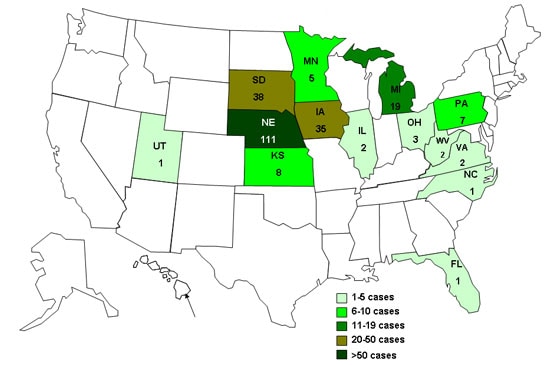
As of May 7, 2009, 235 persons infected with the outbreak strain of Salmonella Saintpaul have been reported from 14 states. The number of ill persons identified in each state is as follows: Nebraska (111), Iowa (35), South Dakota (38), Michigan (19), Kansas (8), Pennsylvania (7), Minnesota (5), Ohio (3), Illinois (2), Virginia (2), West Virginia (2), Florida (1), North Carolina (1), and Utah (1).
De Jong Bros. Farms Recalls Spinach That May Be Contaminated With Salmonella
And in news from Illinois Agriculture this morning we learn of a spinach recall due to possible Salmonella contamination.

De
Jong Bros
. Farms, Incorporated of Lansing, Illinois, has recalled its curly leaf spinach packages sold in 2.5 pound, 5 pound and 10 oz. bags because they have the potential to be contaminated with
FDA Alerts Sprout Growers and Retailers About Specific Lots of Alfalfa Seed Potentially Contaminated with Salmonella
The U.S. Food and Drug Administration (FDA) may be getting to the bottom of the problem of contaminated sprouts. And, the very bottom appears to be the seeds. FDA issued this statement late yesterday:
Preliminary epidemiology regarding the ongoing outbreak of illness from Salmonella Saintpaul in people who had eaten alfalfa sprouts was
Why Not Recall The Seeds In the Sprout-Caused Salmonella Saintpaul Outbreak?
The CDC reports that since mid-March, 35 persons infected with the outbreak strain of Salmonella Saintpaul have been reported from 7 states. The number of ill persons identified in each state is as follows: Michigan (17), Minnesota (4), Ohio (3), Pennsylvania (6), South Dakota (2), Utah (1), and West Virginia (2). Cases are still