Field Trippers Take A Little Piece of Environment Home With Them--The Salmonella Bacteria!

This time of year, you see school kids on all sorts of field trips.   Seems teachers can only stand to be locked up with the little buggers for so long.   What could be better than taking them out to something called "Stone Environmental" camp on a rented piece of the "Purity Springs Resort" in Madison, N.H.?

You are promised that the little juveniles "will take a part of the environment" home with them.  Little did they expect that part of the environment leaving camp with them would be Salmonella bacteria!

That, however, is pretty much the story in New England where first 70 of 98 students from the Woodbury Middle School were struck by Salmonella poisoning while attending the Stone Environmental Camp.   Then,  20 of 30 Dedham Country Day School fifth-graders also got sick on the field trip.

The first group was at Stone during the week of April 13th and the second the following week on April 22-24.   Stone shut down, but is now free to re-open as health officials have discovered the source of the Salmonella was pudding provided to the campers by the Purity Springs Resort.

Dedham Daily News has story here.

Federal Government's Top Food Safety Agencies Say "Do Not Eat Raw Sprouts!"

The Obama Administration is far from having its own people in place to run the food safety machinery of the federal government. However, we are starting to see some of the changes that were promised in last year's campaign. One of these changes is to issue warnings to the public not to eat something once its apparent there is a problem. The latest such warning was issued in regards to raw spouts.

Here's what your federal government had to say in issuing the warning on Sunday:


The U.S. Food and Drug Administration (FDA) and the Centers for Disease Control and Prevention (CDC) today recommended that consumers not eat raw alfalfa sprouts, including sprout blends containing alfalfa sprouts, until further notice because the product has been linked to Salmonella serotype Saintpaul contamination. Other types of sprouts have not been implicated at this time.


The investigation indicates that the problem may be linked to contamination of seeds for alfalfa sprouts. Because suspect lots of seeds may be sold around the country and may account for a large proportion of the alfalfa seeds currently being used by sprout growers, and cases of illness are spread across multiple states, FDA and CDC are issuing this general advisory.

FDA will work with the alfalfa sprout industry to help identify which seeds and alfalfa sprouts are not connected with this contamination, so that this advisory can be changed as quickly as possible.

CDC, FDA and six State and local authorities have associated this outbreak with eating raw alfalfa sprouts. Michigan, Minnesota, Pennsylvania, South Dakota, Utah, and West Virginia have reported 31 cases of illness with the outbreak strain of Salmonella Saintpaul to CDC. Most of those who became ill reported eating raw alfalfa sprouts. Some reported eating raw sprouts at restaurants; others reported purchasing the raw sprouts at the retail level.

The illnesses began in mid-March. Cases are still being reported, and possible cases are in various stages of laboratory testing, so illnesses may appear in other states. No deaths have been reported. The number of infected people may be higher than currently reported because some illnesses have not yet been confirmed with laboratory testing.

The CDC and FDA recommend at all times that persons at high risk for complications, such as the elderly, young children, and those with compromised immune systems, not eat raw sprouts because of the risk of contamination with Salmonella or other bacteria. Salmonella is an organism that can cause serious and sometimes fatal infections in young children, frail or elderly people, and others with weakened immune systems. Healthy individuals infected with Salmonella often experience fever, diarrhea (which may be bloody), nausea, vomiting and abdominal pain. In rare circumstances, infection with Salmonella can result in the organism getting into the bloodstream and producing more severe illnesses, such as meningitis and bone infections.

Initial investigation results trace the contaminated raw alfalfa sprouts to multiple sprout growers in multiple states. This suggests a potential problem with the seeds used, as well as the possible failure of the sprout growers involved to appropriately and consistently follow the FDA Sprout Guidance issued in 1999. The guidance recommends an effective seed disinfection treatment immediately before the start of sprouting (such as treating seed in 20,000 parts per million Calcium hypochlorite solution with agitation for 15 minutes) and regularly testing the water used for every batch of sprouts for Salmonella and E coli O157:H7 contamination.

Nevada Woman, Shirley Shultz, Hospitalized Due to Salmonella Spices from Union International Food Company and CJ United Corporation

A 77-year-old Dayton woman is recovering after being hospitalized for salmonella poisoning from pepper.  Shirley Shultz's infection coincides with recalls of white and black pepper by California-based companies Union International Food Co. and CJ United Corp. over the last month.  Shultz was discharged Tuesday from a Carson City hospital after spending over a week there.

The Nevada Health Division says Shultz is among nine Nevadans infected with salmonella from pepper this year, but she's the only one who had to be hospitalized.  The state had five reported cases in Washoe County, two in Carson City and one each in Lyon and Elko counties.  Fifty similar cases were reported in California, Oregon and Washington.

Experts For The Victims Get Inside The Peanut Corporation of America's Plants in Texas and Georgia

Experts for lawyers representing the victims of the Salmonella Typhimurium inspected both the Peanut Corporation of America's Plainview, TX and Blakely, GA plants this week.  With nine deaths and hundreds of illnesses linked to the Salmonella contamination found inside the PCA facilities, media attention on this week's first inspections by outside experts was high.

Jennifer Emert at Georgia's WALB News spoke to some of those experts and painted a sickening picture of the condition of the plants now associated with the largest recall of peanut products in U.S. history.   Emert reported:

Pictures taken Thursday inside the Blakely Peanut Corporation of America plant, show disturbing images, a screwdriver left inside a machine where peanuts were stored. A small piece of wire inside the hopper with peanuts matching wire found inside the plant's maintenance area, and that's not all.

"When he pulled the bottom release door of the hopper and let some of the peanut product down there was a wasp and a beetle that was alive," said George Pearl, Alps Evidence & Photo President.

"A lot of grease, a lot of oil, a lot of peanut waste that's trapped in pieces of equipment," said Roy Costa, a former Health Inspector.

The Plainview, Texas plant was worse with dead mice on the floor. Attorney Bill Marler and his team of six inspectors spent several hours looking the plant over from the leaks in the roof to the gaps in the bay doors.

Rodents and insects can spread the Salmonella bacteria.   As of noon yesterday, the U.S. Food and Drug Administration (FDA) was reporting 3,913 peanut and peanut related products being on the recall list because they have ingredients from the PCA plants.

More from WALB here.

Sprouts and Spice All Adding Up To Salmonella From Michigan To California

We were chatting earlier today with one of the nation’s experts on food borne illnesses. He was making the point that people in good health, in the prime of their life, can be cut down by food-borne illnesses like Salmonella.

And Salmonella seems to be everywhere this spring. Southeast Michigan has 16 confirmed cases of Salmonella with two of the ill in hospitals. Michigan health officials are warning state residents not to eat raw sprouts until more is known.  The Michigan sprouts problem may be related to the outbreak earlier this year blamed on an Omaha company.

Meanwhile across the country in California it’s spice not sprouts that is making people sick with Salmonella. The Centers on Disease Control and Prevention (CDC) says 45 of the 60 people known to be sick with the spice-related Salmonella are residents of the Golden Bear State.

The Sacramento Bee summed up the situation this way:

White and black pepper and curry powder sold in 5-pound containers under the "Natural and Delicious" label by CJ United Corp., based in Oakland, have been recalled, according to a statement on the state Department of Public Health's Web site.

Sacramento County had five reported salmonella cases, and one case has been reported in both Placer and El Dorado counties, according to Ron Owens, a Department of Public Health spokesman.

The following counties also have reported salmonella cases linked to the spice recall: Santa Clara, seven; Alameda, five; San Francisco, five; San Mateo, five; Contra Costa, four; San Joaquin, two; Sonoma, two; and one case each in Humboldt, Madera, Marin, Merced, Mono, Napa, Santa Cruz and Solano.

The corporation received the products from U.F. Union International Food Co., which is at the nexus of a spice recall that began late last month.  Union International Food has recalled all of its products produced in Union City because of potential contamination with salmonella.

Spice Recall Expanded; All Listed Here May Be Contaminated With Salmonella

 FDA announced that Union International Food Co. is expanding a spice recall to include all Lian How brand and Uncle Chen brand sauces, oil and oil blends in various size packages because the products may be contaminated with salmonella, an organism that can cause serious and sometimes fatal infections, especially in young children, the elderly and those with weakened immune systems. The company had previously recalled Lian How brand and Uncle Chen brand dry spices.

California state health department officials say the salmonella outbreak has sickened 33 people throughout northern and central California, and nine others in Nevada, Oregon and Washington. No deaths have been reported. Officials say most of the people sickened appeared to have been exposed to salmonella while eating at Asian restaurants that used the company's spices.The company said salmonella was isolated from an open container of Lian How white pepper.

The Uncle Chen and Lian How brand products were distributed to retailers, wholesalers, distributors, restaurant suppliers and restaurants. Details: By phone at 510-471-6799; on the Web at http://www.ufunionfood.com.

The recall includes the following Lian How brand items:

Iowa Health Officials Kept Focus For Salmonella St. Paul Outbreak On SunSprout Enterprises

The recall of sprouts by SunSprout Enterprises Inc. of Omaha, Neb did not come quick enough for 34 Iowans including 3 living clear across the state on the banks of the Mississippi River in Scott County.

The 34 Iowans are suffering from Salmonella St. Paul, the very bacteria found in the recalled sprouts. After the Omaha firm's March 3 recall of alfalfa sprouts, onion sprouts, and gourmet sprouts because of possible salmonella contamination, people in the upper midwest began getting sick.

According to the Quad City Times, the three Scott County victims ate the bad sprouts at at a local restaurant, but health officials are not holding it accountable.  The newspaper reported that:

The U.S. Food and Drug Administration, or FDA, announced March 3 a recall of alfalfa sprouts, onion sprouts and gourmet sprouts because of a possible health risk.

Several cases of Salmonella St. Paul were reported in Nebraska and Iowa, and the supplier, SunSprout Enterprises Inc. of Omaha, Neb., voluntarily recalled its product.

However, those warnings came after the area restaurant had unknowingly served sprouts supplied by the Omaha firm and also after the three customers had eaten the affected food items, Hall said. “The restaurant would not have had the information at the time to know sprouts were a concern,” she added.

Quad City health officials were aggressive in contacting area sprout outlets as soon as the warning was issued.   For more from the QCT, go here.

A Rainy Night In Georgia Is Followed By Spiked Salmonella Levels The Next Morning!

A rainy night in Georgia
I believe that it's raining all over the world
I feel that it's raining all over the world

Scientific American is out with a report today that says when you add that famous rain to Georgia you end up with lot's of Salmonella.   Talk about taking the romance out of a famous Ray Charles song!

The magazine reports that:

Researchers at the University of Georgia in Athens (U.G.A.) have found that rain ups the risk of salmonella in rivers and streams—and, in turn, in products nourished by and washed in tainted runoff waters. The scientists report in Applied and Environmental Microbiology that 79 percent of water samples from rivers and streams in southern Georgia collected and tested over a year contained the rod-shaped bacteria; concentrations were highest in specimens gathered in the summer months and right after it rained.

Study co-author Erin Lipp, an associate professor of environmental health sciences at U.G.A.'s College of Public Health, says the findings indicate that officials trying to trace the source of salmonella contamination should put untreated surface water at the top of their suspect list.

After a downpour, rainwater accumulates on ground surfaces or in bodies of water. Before it reaches a final destination, the surface water may come into contact with salmonella—which lives in the intestinal tract of humans and animals and can be spread via their feces and vomit. Contaminated water may seep into porous soil—and thereby infiltrate irrigation systems used to nourish fields and wash produce.

There were reports of ponding on the roof and leaks into the Peanut Corporation of American facility in Blakely, GA, which is responsible for the largest ongoing recall of peanut products in U.S. history.

Check here for more from Scientific American.


Bangladeshi Freshwater Fish Recalled Because Of Salmonella Contamination

Asia Cash & Carry Inc. in Maspeth, New York, is recalling 34 cases of CROWN FARMS brand “KESKI” Frozen Fish (Bangladeshi Freshwater Fish) in 300gm packages with production code JULY 2008 because the product has the potential to be contaminated with Salmonella.

CROWN FARMS brand “KESKI” (Bangladeshi Freshwater Fish) Fish was distributed to retail stores in NY, NJ, and MA.

The KESKI Frozen Fish was imported from Bangladesh, and distributed in cases containing vacuum-packed 300-gram packages with a production date of JULY 2008, expiration date JUNE 2010, and UPC code 5060065431145. There are 32 Blocks -300 gram packages per case.

No illnesses associated with the recall have yet been reported.

 Salmonella is an organism, which can cause serious and sometimes fatal infections in young children, frail or elderly people, and others with weakened immune systems. Healthy persons infected with Salmonellaoften experience fever, diarrhea (which may be bloody), nausea, vomiting and abdominal pain. In rare circumstances, infection with Salmonella can result in the organism getting into the bloodstream and producing more severe illnesses such as arterial infections (i.e., infected aneurysms), endocarditis and arthritis.

For more from FDA, check this out.

Get Your Widgets! - Salmonella Peanuts and Pistachios

FDA Product Recall List
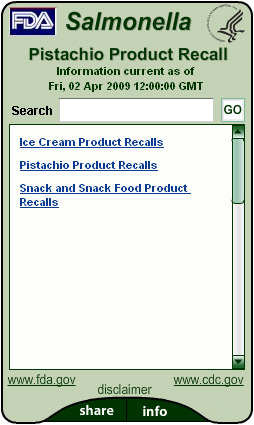

FDA Salmonella Typhimurium Outbreak 2009. Flash Player 9 is required.FDA pistachio product Recall Widget. Flash Player 9 is required. Visit http://www.accessdata.fda.gov/scripts/pistachiorecall/index.cfm to search for pistachio product recalls for more information.
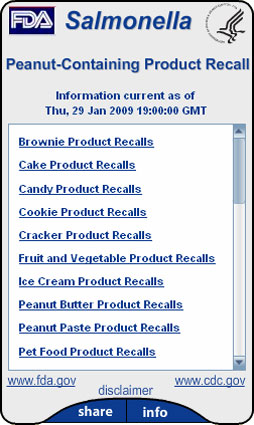


FDA Product Recall List


FDA Salmonella Typhimurium Outbreak 2009. Flash Player 9 is required.FDA Peanut Product Recall Widget. Flash Player 9 is required. Visit http://www.accessdata.fda.gov/scripts/peanutbutterrecall/index.cfm to search for peanut product recalls or call CDC-INFO at 1-800-232-4636 for more information.


Send In The Clowns? No, Send In The U.S. Marshals!

 For the last few weeks the FDA and Westco Fruit and Nuts Inc. (Westco/Westcott), have been "negotiating" on whether a recall would be issued of Westco/Westcott peanut products.  Today the FDA dropped the hammer down.  From the FDA Website:

At the request of the U.S. Food and Drug Administration, U.S. Marshals today executed an inspection warrant at Westco Fruit and Nuts Inc. (Westco/Westcott), an Irvington, N.J.-based company. Westco/Westcott did not provide access to distribution documents and declined to recall products after an FDA request. Regulated companies are required by law to grant FDA entry for inspection, as well as provide access to distribution records. The FDA does not have authority to compel companies to recall food products, such as peanuts.  The company, which produces and distributes peanuts and peanut products, received peanuts and peanut product from the Peanut Corporation of America (PCA), a Georgia company that recalled products in January due to concerns of Salmonella contamination.  Despite PCA's effort to remove the affected product from the market and FDA's intervention, Westco/Westcott has refused to recall its products.

"FDA's enforcement action against Westco Fruit and Nuts is an appropriate step toward removing potentially harmful products from the marketplace, especially when, as in this case, a company is unwilling to share information FDA needs to ensure food safety," said Michael Chappell, the FDA's acting associate commissioner for regulatory affairs. "The FDA uses all appropriate legal means necessary to obtain information and fully investigate firms or individuals who put the health of consumers at risk."  On March 23, 2009, the FDA formally requested Westco/Westcott to initiate a recall of all of its products containing peanuts from PCA because such products may be contaminated with Salmonella. On March 26, 2009, the FDA also issued a formal notice to Westco/Westcott requesting access to certain records concerning the distribution of PCA peanut containing products. The company declined both requests.

Investigations by the FDA and the Centers for Disease Control and Prevention identified products from PCA's Blakely, Ga., facility as a source of the current Salmonella Typhimurium outbreak. These efforts led to PCA's recall of peanuts and peanut-derived products.  Between Nov. 19, 2008, and Dec. 30, 2008, Westco/Westcott received three shipments of Oil Roasted Salted Redskin Jumbo Peanuts from PCA's Georgia facility.  Westco/Westcott sold these peanuts in various size/packaging configurations and also used them as an ingredient in a variety of mixed nut products and trail mix produced between Nov. 19, 2008, and early February 2009.  On Feb. 9, 2009, New Jersey officials executed an embargo action at Westco/Westcott's distribution facility to prevent the company from further distributing potentially contaminated peanuts or peanut-derived products in the company's inventory.

Last week ABC reported:

A federal official said Moradi [Westco/Westcott] "ran away and hid" when government inspectors showed up at his plant. Moradi acknowledged hiding from FDA inspectors but said it was because they had repeatedly visited him and staked out his plant, and he was frightened.

"I was intimidated," Moradi said. "I was scared of them."

Moradi described Westco as "a tiny little business" with annual sales of a little more than $1 million.

"These people are basically doing it to cover their a**. FDA is doing this to cover their a**," he said. "For seven years, they did not do inspections [at the PCA plant in Georgia] and now at the cost of a tiny little small business they are coming, and they are forcing me and they have no proof. "

The real question is whether if FDA had recall authority if companies would fight the recall and drag out the battle like Westco/Westcott has done?  The reality is that the "voluntary" recall system has worked quite well over the years.  There have been only a handful of folks like Westco/Westcott who refuse to put public health before profits.

FDA Alerts the Public to Uncle Chen and Lian How Brand Dry Spice Product Recall Due to Salmonella Illnesses

The U.S. Food and Drug Administration (FDA) is alerting the public to a voluntary recall by Union International Food Company (Union City, Calif.) of the company’s dry spice products. The recall is based on an investigation of an ongoing foodborne illness outbreak of Salmonella Rissen. This investigation is being conducted in collaboration with state health officials in California, Oregon, Nevada, Washington and the U.S. Centers for Disease Control and Prevention (CDC). The company’s products are distributed in these states and Arizona.

The dry spices being recalled were sold primarily to ethnic restaurants, wholesalers, and retail outlets under the brand names “Lian How” and “Uncle Chen.” At this time, the distribution of products appears confined to the western region of the country.

The recalled products sold at retail outlets include 5-ounce plastic jars of the following Uncle Chen brand dry spices: Whole White Pepper, Ground White Pepper, Whole Black Pepper, and Ground Black Pepper. The Lian How brand products are generally sold to restaurants and wholesalers; a full list of recalled products appears below.

A total of 42 cases of Salmonella Rissen infection have been reported to the CDC by health officials in California, Nevada, Oregon, and Washington. Most of the reported cases (33) are in California.

Information, including epidemiologic information and preliminary test results on samples collected, from health authorities in the affected states, links white and black pepper as foods possibly associated with illnesses. The FDA and California officials are inspecting the Union City, Calif. processing facility and have collected environmental and product samples.

The FDA advises consumers who may have purchased these dry spices to dispose of them. Restaurants, retail outlets, and other purchasers should stop using the recalled dry spices immediately and dispose of them. Also, the public is advised to discard any food made with these products and to remove the dry spices from dispensers on consumer tables and at kitchen work stations. All equipment and utensils that have come into contact with these dry spices should be washed, rinsed and sanitized before further use.

Salmonella can cause serious and sometimes fatal infections in young children, frail or elderly people, and others with weakened immune systems. Healthy persons infected with Salmonella often experience fever, diarrhea (which may be bloody), nausea, vomiting and abdominal pain. In rare circumstances, infection with Salmonella can result in the organism getting into the bloodstream and producing more severe illnesses such as arterial infections (i.e., infected aneurysms), endocarditis and arthritis. Individuals who are experiencing these symptoms should contact a doctor immediately or go to an emergency room for evaluation.

Feds Find Salmonella At Setton's Plant; Company Expands Pistachio Recall

There are a couple of developments today in the pistachio front.  First the feds have found traces of salmonella in the Terra Bella, California processing facility.   That was probably why Setton Pistachio earlier today expanded its recall of pistachios to include all roasted shell pistachios and in-shell pistachios "due to possible salmonella contamination."

Withdrawal from its 2008 crop also includes raw shell pistachios that are not subsequently roasted before sale, according to the second-largest pistachio processor in the United States.

Setton Pistachio issued a nationwide recall of pistachios on March 30, a week Kraft Foods Inc told U.S. health regulators that its Back To Nature trail mix was contaminated with salmonella and identified Setton as the source.

As part of its update today, FDA said:

Initially, the firm’s recall was limited to certain lots of roasted pistachios. Information from the joint FDA and California Department of Public Health inspection indicates the presence of Salmonella in critical areas of the facility and the potential for cross-contamination between raw and roasted products. After this information was shared with Setton, the firm decided to expand its recall.

Meanwhile, the FDA's list of pistachio products that have been caught up in the recall has gone over 144 separate items and that count does not include what's been added over the past weekend.  Just not eating pistachios until FDA gives the all clear sign is the wise thing to do.  If you just cannot wait, at least check the list here to be sure you are avoiding the risky items.

Washington Post Reports FDA Found 20 More Peanut Product Makers Operating Off The Radar

 One of the awesome facts of the whole peanut/ salmonella outbreak was that the Peanut Corporation of America had gone for years with either a license or any inspections.  But guess what?  It was not an isolated incident.   


Washington Post Staff Writer Lyndsey Layton reports in Friday's WP that:

During its investigation of the Peanut Corporation case, the FDA discovered about 20 additional facilities that have been making peanut products without the knowledge of federal regulators. It learned about the facilities because they were buying peanuts from PCA, said Michael Herndon, an FDA spokesman. The agency will not name the 20 facilities or say where they are located, he said, adding that FDA inspectors are planning to visit each site shortly.

"It's a little depressing, but not surprising, that they found another 20 facilities they didn't know about," said Jean Halloran, director of food safety for Consumers Union. She pointed to the fact that unknown to federal regulators, one of Peanut Corporation of America's three facilities had operated in Plainview, Tex., for four years until the outbreak.

It looks to us like there was a pretty big chunk of the peanut industry operating off the radar.   We wonder how much of the food industry is managing this trick of being in the market sans regulation or oversight.  It unlikely that the peanut industry is the only part of the food business that maintains sub-prime operators.   

See the entire WP story here.


Here We Go With Pistachio Recall List

According to the FDA Website, the FDA and the California Department of Public Health (CDPH) are investigating Salmonella contamination in pistachio products sold by Setton Pistachio of Terra Bella Inc, Calif. The company has stopped all distribution of processed pistachios and will issue a voluntary recall involving approximately 1 million pounds of its products. Because the pistachios were used as ingredients in a variety of foods, it is likely this recall will impact many products. In addition, the investigation at the company is ongoing and may lead to additional pistachio product recalls. The contamination involves multiple strains of Salmonella.

Thus far, also according to the FDA, several illnesses have been reported by consumers that may be associated with the pistachios. It is not yet known whether any of the Salmonella strains found in the pistachio products are linked to an outbreak.  Strains thus far are Montevideo, Newport, Seftenberg and Larochelle.

Here we go again - Pistachios and other Pistachio Containing Products Recall List - Information current as of 12 noon March 31, 2009 - 63 entries in list.