
 Setton Pistachio of Terra Bella, Inc. has been forced into a nationwide recall of specific lots of bulk roasted shelled pistachios and 2,000 lbs., 1,700 lbs., 1,800 lbs. and 1,000 lbs. tote bags of roasted inshell pistachios sold to wholesale customers due to potential contamination with the Salmonella organism.
This is the recall that has led to the news reports warning against eating any pistachios.
Certain bulk roasted inshell and roasted shelled pistachios shipped on or after September 1, 2008 are involved in the recall. The bulk product was distributed throughout the United States. The Company learned that a small amount of roasted shelled pistachios processed by Setton Pistachio and received by a commercial customer in late 2008 recently tested positive for Salmonella.
The Company is asking those firms who received bulk product and have further processed, repackaged, or distributed the affected products to recall those products and contact FDA.
Retail products in the recall include: Setton Farms brand roasted salted shelled pistachios in 9 oz. film bags, UPC Code: 034325020252 with a "Best Before" date between 01/06/10 and 01/19/10. This product was distributed in the following states: SC, GA, FL, NC, VA, TN, KY. Consumers should not consume this product and should return what they may have to the place of purchase for a full refund. Setton has established a toll free number, (888) 228-3717, for consumers to call for further information.
Here’s the press release from Setton Farms that was released by FDA.
Meanwhile, keep reading for what FDA had to say about the larger alert.Continue Reading Pistachios Sold At Both Wholesale And Retail Levels Recalled; Nationwide Alert Issued By FDA

 A year ago, the town of Alamosa was in crisis. Hundreds of people were sick from a Salmonella outbreak. The whole town was drinking bottled water because the city’s public water supply was contaminated.
  The FDA announced today that the Georgia Nut Company is recalling certain bulk wholesale and retail products containing shelled pistachio nuts that have the potential to be contaminated with the Salmonella organism. The Company said it identified the potential as a result of a rigorous sampling and testing regimen it conducted with respect to
 .jpg) The outbreak that’s sickened people in four Midwest states has been tied to SunSprout Enterprises’ sprouts that were distributed to grocery stores and restaurants. The Omaha company "voluntarily" recalled its products.
The outbreak that’s sickened people in four Midwest states has been tied to SunSprout Enterprises’ sprouts that were distributed to grocery stores and restaurants. The Omaha company "voluntarily" recalled its products. The Food & Drug Administration (FDA) said Asia Cash & Carry Inc. of Maspeth, N.Y., recalled the Bangladeshi freshwater fish because of the potential of salmonella contamination.
 Just as FDA was putting out the press release for SunSprout’s "voluntary recall," counts of illnesses due to the sprout-caused salmonella outbreak were going up in the impacted states.
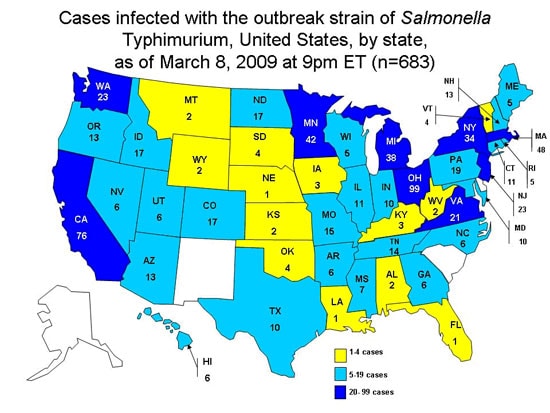 As of 9 PM EDT, Sunday, March 8, 2009, 683 persons infected with the outbreak strain of Salmonella Typhimurium have been reported from 46 states. The number of ill persons identified in each state is as follows: Alabama (2), Arizona (13), Arkansas (6), California (76), Colorado (17), Connecticut (11), Florida (1), Georgia (6), Hawaii
 About 50 cases from Iowa, Kansas, Nebraska, Missouri, and South Dakota have been linked to the outbreak, according to a recent press release from the South Dakota Department of Health. Nebraska has identified 15 ill. South Dakota has identified five cases from five of its southeastern counties and that more cases were pending. Iowa’s