Crackling Pork Recalled Due To Salmonella Contamination

When we first heard there was something going on with fully cooked crackling pork, we thought that it must have something to do with the Farm Bill.   But, no, it seems it's about a small recall of 1,100 pounds of crackling pork.

The U.S. Food Safety and Inspection Service said the pork was produced on 5/12/08 by Miami-based Sofia Chicharones Inc. and it may be contaminated with Salmonella.

It's packaged in one and five pound bags as "Fully Cooked Pork Cracklings with Attached Skin."
Each package has an "EST 21055" marking and  a packed date of  051208-1.

The fully cooked pork crackling was sold in the company's Miami store on the same date it was made.

FSIS officials say anyone who bought the Salmonella-tainted pork should get rid of it.


Five Restaurant Employees Spread Rare Type Of Salmonella To Customers

Five employees of a Mexican restaurant in Norwalk, Ohio have tested positive for the rare S. Muenchen type of Salmonella.  It's  match with at least 29 customers of the Casta Fiesta restaurant who also became sick.  Another seven customers also contracted a less rare type of Salmonella.
'We do not suspect that the salmonella is circulating in the food supply because no other local or statewide restaurants are suspected as a source. When a food supplier is the source of an outbreak, we typically see people who have eaten at various restaurants statewide,'' local Health District Commissioner Tim Hollinger told the Morning Journal newspaper.

The newspaper reported that two containers of leftovers from Casa Fiesta patrons who got salmonella were sent to the Ohio Department of Health for testing and were returned negative for the disease.

The Health District told the Casa Fiesta employees who had salmonella and restaurant management that the workers are prohibited from returning to work until they have received two clean tests taken at least 24 hours apart. The workers have not returned to work, the Morning Journal reported.

The complete story can be found here.


Multistate Outbreak of Human Salmonella Infections Caused by Contaminated Dry Dog Food --- United States, 2006--2007

This is a first.   Dry dog food did cause a Salmonella outbreak in humans.  That according to today's Morbidity and Mortality Weekly Report, published by the Centers for Disease Control and Prevention.

Further,  dry dog food may be an under-recognized source of illness in people, especially small children, according to the CDC report.

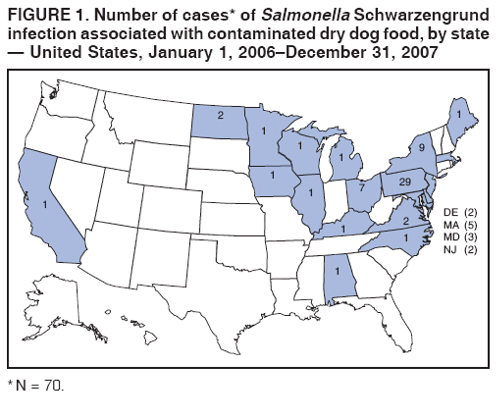
FIGURE 1. Number of cases* of Salmonella Schwarzengrund
infection associated with contaminated dry dog food, by state
-- United States, January 1, 2006-December 31, 2007

Here's some of what MMWR said:

During January 1, 2006--December 31, 2007, CDC collaborated with public health officials in Pennsylvania, other states, and the Food and Drug Administration (FDA) to investigate a prolonged multistate outbreak of Salmonella enterica serotype Schwarzengrund infections in humans. A total of 70 cases of S. Schwarzengrund infection with the outbreak strain (XbaI pulsed-field gel electrophoresis [PFGE] pattern JM6X01.0015) were identified in 19 states, mostly in the northeastern United States. This report describes the outbreak investigation, which identified the source of infection as dry dog food produced at a manufacturing plant in Pennsylvania. This investigation is the first to identify contaminated dry dog food as a source of human Salmonella infections. After handling pet foods, pet owners should wash their hands immediately, and infants should be kept away from pet feeding areas.

On May 8, 2007, the Pennsylvania Bureau of Laboratories reported three cases of S. Schwarzengrund infection with indistinguishable PFGE patterns to CDC's PulseNet.* On June 9, 2007, after PulseNet identified cases in Ohio and other states, CDC's OutbreakNet team was notified of a potential multistate outbreak of S. Schwarzengrund infections. During June 2007, the Pennsylvania Department of Health (PADOH) interviewed persons identified by PulseNet as infected with the outbreak strain of S. Schwarzengrund. These initial interviews suggested exposure to dogs or dry dog food as a possible source of infection. Thirteen infected persons from Pennsylvania were questioned about dog-related exposures: eight (62%) owned one or more dogs, and the other five reported regular contact with a dog. Seven of the eight persons who owned dogs were able to recall the types of dog food they had purchased recently. Several brands had been purchased, but persons in the households of six patients recalled purchasing dog food products made by manufacturer A. These interviews suggested exposure to dogs or dry dog foods as a possible source of infection.

PADOH collected dog stool specimens and opened bags of dry dog food from the homes of the 13 Pennsylvania patients. The outbreak strain of S. Schwarzengrund was isolated from five of 13 dog stool specimens and two of 22 dry dog food specimens collected from the homes. The contaminated dry dog food bags were two different brands (brand A and brand B), both produced by manufacturer A at plant A in Pennsylvania.

In July 2007, the Ohio Department of Health also interviewed persons infected with the outbreak strain of S. Schwarzengrund and collected two dog stool specimens from one patient's home. The outbreak strain of S. Schwarzengrund was isolated from one of the dog stool specimens. The dog recently had been fed brand A dry dog food, but the bag of dog food was no longer available for testing.

Go here for the rest of MMWR, go here.  There also a Washington Post story here.

Numbers Grow In Princeton University Salmonella Outbreak

"Salmonella outbreak plagues University" headlines today's story by Jack Ackerman in The Daily Princetonian.  

Since we first reported on students and staff getting sick at Princeton Univesity, the only thing that has changed is the rising numbers.   The latest totals are 16 confirmed salmonella infections, 15 students and one staff member.  Lab reports from stool samples collected from 59 others have yet to come in.

The Daily Princetonian says the investigation is focused on the dining faciliites inside the Frist Campus Center.   Princeton has switched produce suppliers,  closed salad bars temporarily in the Frist Gallery, and stopped serving some foods "commonly connected to salmonella infections."

A Princeton spokesman says the lastest onset of anyone getting salmonella on campus is April 30th.   Frist is very nearly in the exact center of the campus marked with the "H" on this map.

Ten Salmonella Illnesses Traced in Norwalk Ohio Casa Fiesta

Ohio Health officials are working to identify the source of a salmonella scare that sent 10 people to the hospital last week in Norwalk. However, The common thread linking the 10 victims together is that they all ate at Casa Fiesta, 196 Milan Avenue in Norwalk on April 24. That restaurant voluntarily closed its doors Thursday while food samples from the restaurant are tested at the Ohio Department of Health to find the source of the bacteria.

Salmonella is one of the most common enteric (intestinal) infections in the United States. Salmonellosis (the disease caused by Salmonella) is the second most common foodborne illness after Campylobacter infection. It is estimated that 1.4 million cases of salmonellosis occur each year in the U.S.; 95% of those cases are foodborne-related. Approximately 220 of each 1000 cases result in hospitalization and eight of every 1000 cases result in death. About 500 to 1,000 or 31% of all food-related deaths are caused by Salmonella infections each year. Salmonellosis is more common in the warmer months of the year.

Salmonella infections occurs when the bacteria are ingested, typically from food derived from infected food-animals, but it can also occur by ingesting the feces of an infected animal or person. Food sources include raw or undercooked eggs/egg products, raw milk or raw milk products, contaminated water, meat and meat products, and poultry. Raw fruits and vegetables contaminated during slicing have been implicated in several foodborne outbreaks. We are involved in representing families of children who have suffered from this bacterium.

Princeton University Is Dealing With Salmonella Outbreak

We hear there's been some salmonella activity on PulseNet during the last few days, and now comes this report of an outbreak at Princeton University where everyone who needs an excuse for delaying a final exam probably now has one.

The University reports that up to 60 students have come down with some sort of stomach flu, while three students and an employee have tested positive for salmonella.

The Philadelphia Inquirer reports that no one involved in the outbreak has any connections to the Princeton University food service.  "Four Cases of Salmonella at Princeton University" can be found here.

PulseNet detects foodborne disease case clusters by pulsed-field gel electrophoresis (PFGE).