Wisconsin Company Recalls Cheese

The Associated Press reports that a cheese importer has recalled about 55,000 pounds of Mexican cheese that could be tainted with salmonella.

The cheese was sold under the name "Queso Cincho de Guerrero" in multiple stores in Georgia, Illinois, Indiana, Michigan and Texas, according to importer MCP Inc., which has its headquarters in Monroe, Wis.

No illnesses have been reported, MCP marketing manager Blanca Berthier said. The recall was issued after the FDA received test results from a sample taken when the cheese was brought into the U.S., she said.

The cheese that could be contaminated was distributed between April 16 and June 26. It is a dry, hard cheese sold in 35 and 40 pound wheels and labeled with the name of its Mexican producer, Quesos Sabrosos Mexicanos.

Fresh Tomatoes Source of Salmonella: CDC

As many as 190 confirmed cases of salmonella poisoning from eating contaminated fresh tomatoes were reported in four multi-state outbreaks last year, the U.S. Centers for Disease Control and Prevention said Thursday in its Morbidity and Mortality Weekly Report.

And because about 97.5 percent of salmonella infections are never confirmed by culture, the number of people sickened from contaminated tomatoes was probably substantially higher, the CDC said.

Last year's outbreaks originated from producers in Florida, Ohio, and Virginia. Sources may have included feces from domestic animals, and contaminated ponds or drainage ditches, the agency said. About 5 billion pounds of fresh tomatoes are eaten each year in the United States.

To help lessen their risk of salmonella infection, consumers should avoid buying bruised or damaged tomatoes, the CDC said. All tomatoes, regardless of their source, should be thoroughly washed under running water just before eating. Tomatoes that appear spoiled should be thrown out, and cut, peeled, or cooked tomatoes should be refrigerated at 40 degrees F (4.4 degrees C) within two hours or discarded.

Click here for the HealthDay Website

Multistate Outbreaks of Salmonella Infections Associated with Raw Tomatoes Eaten in Restaurants --- United States, 2005--2006


During 2005--2006, four large multistate outbreaks of Salmonella infections associated with eating raw tomatoes at restaurants occurred in the United States. The four outbreaks resulted in 459 culture-confirmed cases of salmonellosis in 21 states (Figure). This report describes the epidemiologic, environmental, and laboratory investigations into these four outbreaks by state and local health departments, national food safety agencies, and CDC. The results of these investigations determined that the tomatoes had been supplied to restaurants either whole or precut from tomato fields in Florida, Ohio, and Virginia. These recurrent, large, multistate outbreaks emphasize the need to prevent Salmonella contamination of tomatoes early in the production and packing process. Current knowledge of mechanisms for tomato contamination and methods of eradication of Salmonella in tomatoes is incomplete; the agricultural industry, food safety agencies, and public health agencies should make tomato-safety research a priority.

Salmonella Newport: Multiple States, July--November 2005


A total of 72 culture-confirmed S. Newport isolates with indistinguishable pulsed-field gel electrophoresis (PFGE) patterns (PulseNet XbaI pattern JJPX01.0061 [/ BlnI pattern JJPX01.0021]) were identified from stool specimens collected during July--November 2005 in 16 states (Delaware, Illinois, Maine, Maryland, Massachusetts, Missouri, New Hampshire, New Jersey, New York, North Carolina, Ohio, Pennsylvania, Tennessee, Vermont, Virginia, and Wisconsin) (1). Median patient age was 29 years (range: <1--75 years); 42 (58%) patients were female. Eight (11%) patients were hospitalized, and no deaths were reported.

A case-control study of persons aged 18 --70 years was conducted; 29 case-patients were matched geographically with 140 well community controls in nine states. Illness was associated with eating raw, large, red, round tomatoes at restaurants; 19 (70%) of 27 case-patients ate such tomatoes compared with 26 (20%) of 128 controls (matched odds ratio [mOR]: 9.7; 95% confidence interval [CI] = 3.3--34.9). Implicated tomatoes had been purchased whole and sliced at restaurants. No single restaurant or restaurant chain was associated with the outbreak.

Investigators determined that the implicated tomatoes were grown on two farms on the eastern shore of Virginia. The outbreak strain of S. Newport was isolated from irrigation pond water near tomato fields in this region in October 2005. This region also had been the source of tomatoes for a multistate outbreak of S. Newport infections in 2002 (1); strains from both outbreaks had the same PFGE pattern.

Salmonella Braenderup: Multiple States, November--December 2005


A total of 82 culture-confirmed S. Braenderup isolates with indistinguishable PFGE patterns (PulseNet XbaI pattern JBPX01.0050 [/ BlnI pattern JBPA26.0004]) were identified in eight states (Illinois, Indiana, Kentucky, Massachusetts, Michigan, Ohio, Pennsylvania, and West Virginia) during November--December 2005. Median patient age was 34 years (range: 6--78 years); 51 (67%) patients were female. Eighteen (35%) patients were hospitalized, and no deaths were reported.

A case-control study of persons aged 18--60 years was conducted; 38 case-patients were geographically matched to 108 well community controls in two states. Twenty (52%) of 38 patients had eaten at chain restaurant A compared with 13 (12%) of 108 controls (mOR: 19.9; CI = 4.6--86.6). Among chain restaurant A patrons, illness was associated with eating items containing raw, prediced Roma (i.e., plum) tomatoes (OR: 11.3; CI = 2.0--62.2).

The implicated tomatoes had been grown in one of two tomato fields in Florida and were prediced and packaged at a firm in Kentucky before being shipped to chain restaurant A. The environmental investigation revealed that multiple potential animal reservoirs of Salmonella (e.g., cattle, wild pigs, wild birds, amphibians, and reptiles) were present in and adjacent to the drainage ditches. Environmental samples from the farm, including drainage ditch water and animal feces from around the tomato fields, yielded Salmonella of different serotypes than the outbreak strain.

Salmonella Newport: Multiple States, July--November 2006


A total of 115 culture-confirmed S. Newport isolates with indistinguishable PFGE patterns (PulseNet XbaI pattern JJPX01.0061 [/ BlnI pattern JJPX01.0021]) were identified from stool specimens provided during July--November 2006 in 19 states (Colorado, Connecticut, Delaware, Georgia, Illinois, Kentucky, Maine, Massachusetts, Maryland, Michigan, New Jersey, New York, North Carolina, Ohio, Pennsylvania, Rhode Island, Tennessee, Virginia, and Washington). The PFGE pattern was identical to the pattern observed during the 2005 S. Newport outbreak. Median patient age was 28 years (range: <1 month--86 years); 54 (50%) patients were female. Eight (32%) patients were hospitalized, and no deaths were reported.

A case-control study of persons aged 18--75 years was conducted; 25 case-patients were geographically matched with 41 well community controls in nine states. Illness was associated with eating raw tomatoes in restaurants; 14 (67%) of 21 matched case-patients ate raw tomatoes in restaurants compared with nine (28%) of 32 controls (mOR: 4.9; CI = 1.03--23.3). No single restaurant or restaurant chain was associated with the outbreak. The source of the implicated tomatoes was not determined. An assessment of tomato-growing practices in the suspected region was conducted by the Food and Drug Administration (FDA) during the July 2007 growing season.

Salmonella Typhimurium: Multiple States and Canada, September--October 2006


A total of 190 culture-confirmed S. Typhimurium isolates with indistinguishable PFGE patterns (PulseNet XbaI pattern JPXX01.0604 [/ BlnI pattern JPXA26.0174]) were identified during September--October 2006 in 21 states (Arkansas, Connecticut, Georgia, Indiana, Kentucky, Maine, Massachusetts, Michigan, Minnesota, Nebraska, New Hampshire, New York, North Carolina, Ohio, Pennsylvania, Rhode Island, Tennessee, Vermont, Virginia, Washington, and Wisconsin). The median age of patients was 34 years (range: 2--88 years); 112 (58%) patients were female. Twenty-four (22%) patients were hospitalized, and no deaths were reported.

A case-control study of persons aged 18--70 years was conducted; 59 case-patients were geographically matched with 59 well community controls in nine states. Illness was associated with eating raw, large, red, round tomatoes at a restaurant; 26 (52%) of 50 case-patients ate such tomatoes compared with 12 (24%) of 50 controls (mOR: 3.1; CI = 1.3--7.3).

Implicated tomatoes were traced to a single packinghouse in Ohio supplied by three tomato growers from 25 fields in three counties. Tomato production had ended by the time the packinghouse was implicated. As a result, FDA deferred the investigation until the next growing season and completed the investigation in August 2007.

Salmonella Schwarzengrund Outbreak Investigation, August 2007

CDC Full Story

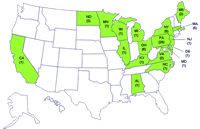
As of September 4, 2007, 62 persons infected with the same strain of Salmonella Schwarzengrund have been reported to CDC from 18 states: Pennsylvania (26 cases), New York (8 cases), Ohio (6 cases), Massachusetts (5 cases), Maine (2 cases), North Dakota (2 cases), Virginia (2 cases), Alabama (1 case), California (1 case), Delaware (1 case), Illinois (1 case), Kentucky (1 case), Maryland (1 case), Michigan (1 case), Minnesota (1 case), New Jersey (1 case), North Carolina (1 case), and Wisconsin (1 case). Of the ill persons for whom an age is available, 39% were one year of age or younger. Of ill persons for whom clinical information is available, 32% developed bloody diarrhea and 10 (25%) were hospitalized. No deaths have been reported.

State and local health departments and CDC continue to receive reports of cases, suggesting the outbreak is ongoing.

Mojito cocktail garnish is recalled

UPI reports that the Food and Drug Administration announced the recall of approximately 5,000 cases of Rimmer Mojito Cocktail Garnish due to possible contamination. Stirrings LLC of Fall River, Mass., initiated the voluntary nationwide recall of the 3.5-ounce packages because they might be contaminated with salmonella bacteria.

The recalled cocktail garnish has a UPC of 80999-00046 with a best by date of 10/27/08, 10/30/08, 11/23/08, 12/01/08, 12/04/08 or 01/03/09 printed on the side of the tin.

Salmonella can cause serious and sometimes fatal infections in young children, frail, or elderly people and others with weakened immune systems.

Rimmer Brand Mojito Cocktail Garnish was distributed nationwide through distributors, retail stores, internet sales and cocktail establishments.